
Insights
Bio-oxidation isn't complex — but the execution is
Bio-oxidation tends to get labelled as "complex," but the idea is actually pretty straightforward. The difficulty isn't the concept — it's making the circuit behave on a live operation.
You're using bacteria to oxidise sulphide minerals, breaking open refractory ore so the gold becomes accessible to cyanide. Marsden & House lay this out clearly: it's a biological pre-treatment step that can unlock serious value where conventional leaching falls short.
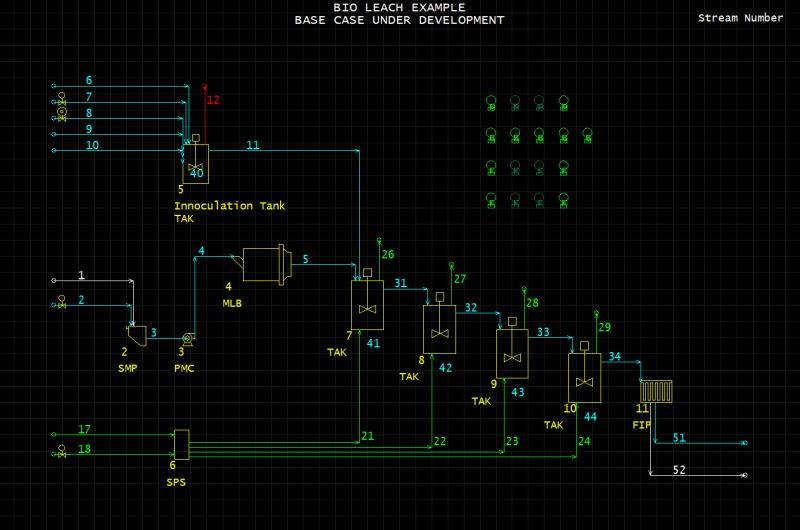
Where it gets tricky
Where it gets tricky is in the execution. Bioleach circuits are sensitive systems. Small shifts in temperature, oxygen transfer, residence time, or nutrient balance can have a big impact on performance and recovery. Get one of those wrong and the economics move with it.
Why we model it
This is where we see real value in modelling. With METSIM®, we build and test bio-oxidation circuits, stress different operating scenarios, and quantify downstream impacts before decisions are made on site. The cost of being wrong in a model is nothing; the cost of being wrong in the plant is measured in recovery and reagent.
At Treo Group, this sits at the intersection of simulation, project delivery, and practical problem solving. Understanding the chemistry is useless if we can't make the process work in the real world — so the modelling is always pointed at a decision someone has to make on the ground.
The takeaway
If you're dealing with refractory ore, bio-oxidation may be the route to value conventional leaching can't reach — provided the circuit is designed and de-risked properly. That's a modelling problem before it's a plant problem.
Dealing with refractory ore?
We model and de-risk bio-oxidation circuits in METSIM® before they're committed to site. Let's talk through your flowsheet.
Talk to a METSIM® engineer